
20-05-2026
SOCIETY'S RELATIONSHIP WITH GOLD AND SILVER IN THE LAST 50 YEARS
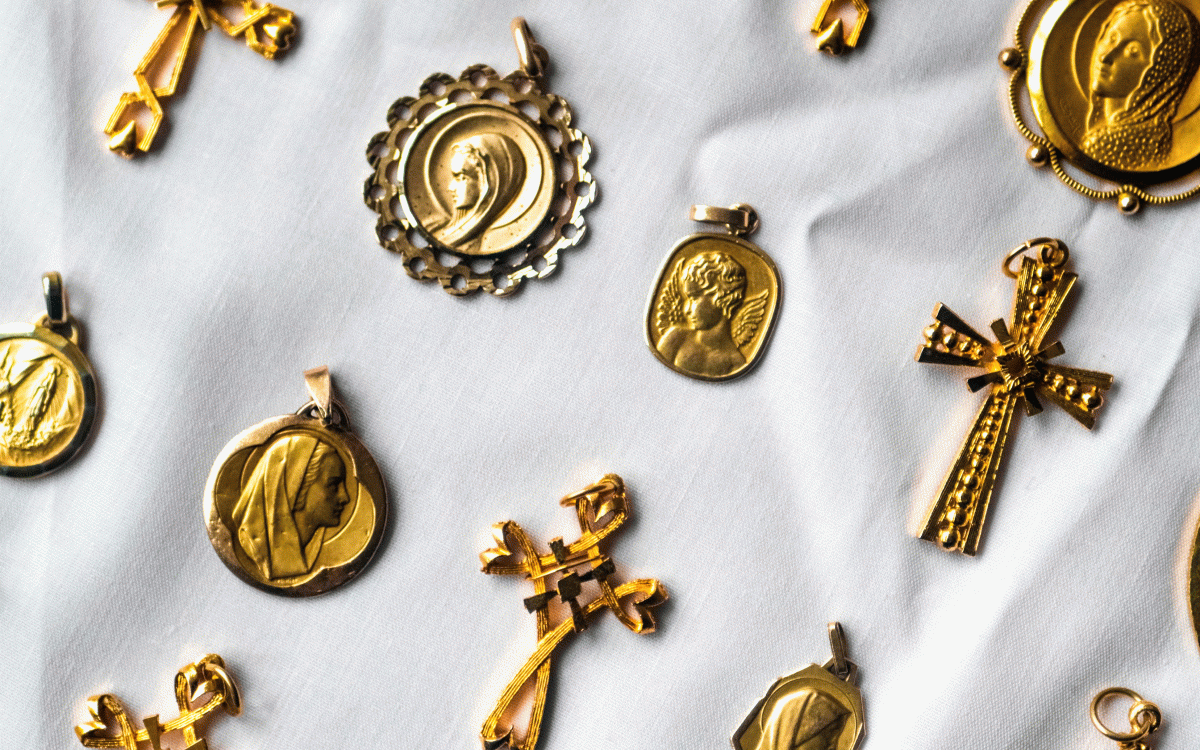
For decades, gold and silver have held a special place in many families. Not only as jewelry or status symbols, but also as a form of savings, inheritance, and financial protection. However, the way society relates to these precious metals has changed dramatically in the last 50 years.
Today, selling gold is commonplace. But it wasn't always this way.
At Calabria Oro, as specialists in buying and selling gold in Barcelona, we see every day how different generations have completely different perceptions of the value of gold, jewelry, and silver. And understanding this evolution also helps us understand why the current market functions so differently than it did decades ago.
50 years ago: gold was bought, not sold.
In the 1960s and 70s, gold had a strong family and heritage component.
It was common for families to buy jewelry as a form of savings, for gold to be given as a gift at weddings, baptisms, or first communions, and for pieces to be passed down from generation to generation. In those days, selling jewelry was uncommon. In fact, many people associated selling gold with difficult financial situations.
Traditional jewelry stores played a very different role than they do today: gold was bought to be preserved, not to obtain quick cash.
Furthermore, access to financial products was much more limited than it is now. For many families, especially in Spain, storing value in gold was a simple and tangible way to protect their savings.
The 1980s and 90s: a shift in mentality. With economic growth and financial modernization, the social perception of gold began to change.
Little by little, new forms of saving emerged, access to credit increased, and jewelry ceased to be seen solely as family heirlooms.
During these years, fashion also changed: costume jewelry became more popular, lighter pieces gained traction, and gold lost some of the everyday prominence it had enjoyed decades earlier. Even so, a strong culture of buying gold jewelry persisted, especially for family celebrations.
The Great Transformation: The 2008 Crisis
One of the biggest social changes related to gold came with the 2008 economic crisis. It was then that many people began selling jewelry for the first time.
Throughout Spain, the buying and selling of gold, pawnshops, and appraisals of antique jewelry increased enormously.
Many families discovered they possessed pieces of significant value and began to see gold not only as something sentimental but also as an immediate source of liquidity.
That moment completely changed the social perception of the sector.
From then on, selling gold ceased to be seen as something exceptional and became a common practice for many people.
The New Generation: Less Jewelry, More Investment
Today, there is a very clear difference between generations.
Older people tend to associate gold with: inheritance, family savings, stability, and tradition. In contrast, younger generations tend to: buy less classic jewelry, prioritize experiences over material possessions, and see gold more as an investment than as a social symbol.
The type of consumption has also changed: smaller pieces are being purchased, designs are more minimalist, and there is greater interest in coins, ingots, or financial investments linked to gold.
And what has happened to silver?
Silver has also undergone a significant transformation.
Decades ago, silver cutlery, picture frames, trays, and decorative objects were very common in homes.
Today, many of these pieces have disappeared from everyday use.
However, silver still has a market: both for investment and for jewelry, watches, and antiques.
Interestingly, many people keep antique silver pieces without truly knowing their value.
Gold continues to convey security.
Although society has changed a great deal, one thing has barely changed: the perception of gold as a symbol of security.
In times of inflation, economic uncertainty, international conflicts, or financial instability, interest in gold tends to increase.
That is why it continues to be one of the most valued assets in the world, even after decades of social and technological changes.
How the buying and selling of gold has also changed
The sector itself has also evolved enormously.
Years ago, many transactions lacked transparency, and there was widespread distrust among customers. Today, users particularly value transparency, clear explanations, professional appraisals, and understanding how the value of their pieces is calculated. More and more people are looking for specialized establishments that can provide them with proper advice before selling gold, silver, or antique jewelry.
Barcelona and the cultural shift in gold
In cities like Barcelona, this change has been especially noticeable.
Currently, families who cherish inherited antique jewelry coexist with investors interested in precious metals, individuals selling pieces they no longer use, and clients seeking immediate and secure liquidity. The relationship with gold is no longer solely sentimental or economic: it is now also practical.
Conclusion
Over the last 50 years, society has shifted from buying gold to preserve it for generations to using it as a financial tool, investment, or source of liquidity. Jewelry no longer holds the exact same significance it once did, but gold continues to occupy an important place in the economy and in family culture. And although fashions and generations may change, one thing remains constant: the value people place on what they consider safe, durable, and valuable over time.